The oil and gas industry operates in one of the world’s most demanding environments. From offshore drilling platforms and refineries to pipelines and LNG processing plants, critical assets are expected to perform continuously under extreme temperatures, high pressures, corrosive conditions, and heavy workloads.
A single equipment failure can halt production, compromise worker safety, trigger environmental incidents, and result in millions of dollars in unexpected costs. As operational complexity and regulatory expectations continue to increase, relying solely on reactive repairs is no longer a sustainable maintenance strategy.
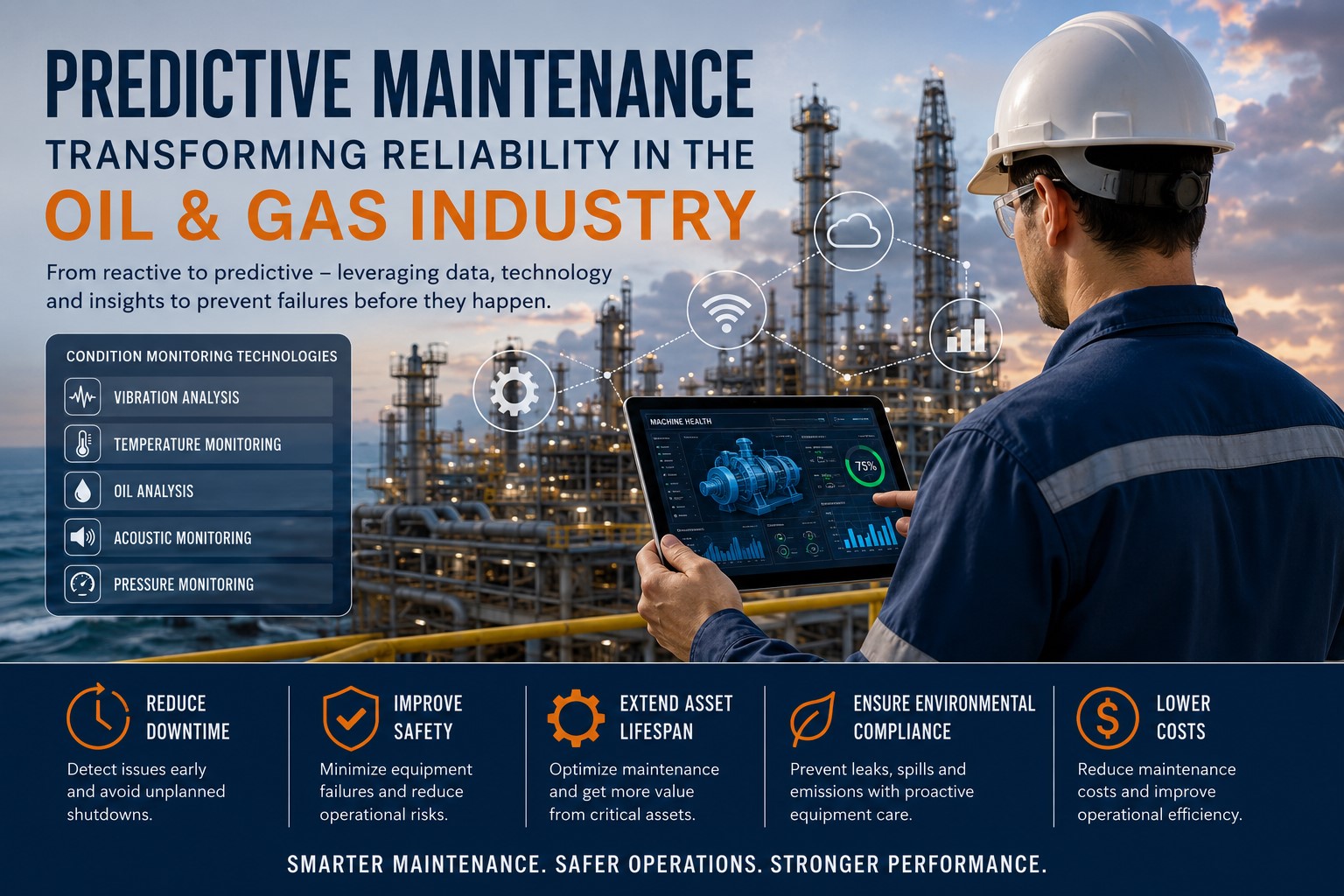
Traditionally, organizations have depended on preventive maintenance, where equipment is inspected and serviced at scheduled intervals regardless of its actual condition. While this approach significantly reduces unexpected failures, many companies are now embracing predictive maintenance – a data-driven strategy that uses sensors, analytics, artificial intelligence (AI), and machine learning to identify potential failures before they occur.
By combining preventive maintenance with predictive maintenance, organizations can maximize equipment reliability, improve asset utilization, reduce operating costs, and strengthen long-term business performance.
Today, predictive maintenance is rapidly becoming the preferred strategy for critical assets because it enables maintenance teams to make decisions based on real-time equipment health rather than fixed maintenance schedules.
Minimize Unplanned Downtime with Early Fault Detection
One of the primary objectives of predictive maintenance is to prevent unexpected equipment failures before they interrupt operations.
Oil and gas facilities rely on a wide range of critical assets, including:
- Compressors
- Pumps
- Gas turbines
- Heat exchangers
- Pipeline valves
- Drilling equipment
- Industrial engines
- Power generators
Traditionally, these assets are serviced according to predefined maintenance schedules. However, equipment can sometimes fail between scheduled inspections due to unforeseen operating conditions.
Predictive maintenance overcomes this limitation by continuously monitoring equipment health through technologies such as:
- Vibration analysis
- Thermal imaging
- Oil condition monitoring
- Acoustic monitoring
- Pressure and temperature sensors
- IoT-enabled equipment diagnostics
When abnormal operating patterns are detected, maintenance teams receive early alerts, allowing repairs to be planned before a failure occurs.
The result is:
- Reduced production interruptions
- Higher equipment availability
- Improved operational reliability
- Lower emergency maintenance costs
Improve Worker Safety and Reduce Operational Risks
Safety remains one of the highest priorities in the oil and gas industry.
Equipment failures involving high-pressure systems, rotating machinery, combustible gases, or hazardous chemicals can create serious risks for personnel and surrounding communities.
Predictive maintenance significantly improves workplace safety by identifying hidden equipment degradation before it develops into a hazardous situation.
For example, predictive analytics can detect:
- Bearing wear
- Excessive vibration
- Motor overheating
- Corrosion
- Seal degradation
- Pipeline pressure abnormalities
- Electrical insulation failures
Instead of waiting for visible signs of failure, maintenance teams can intervene early, reducing the likelihood of equipment breakdowns that may lead to fires, explosions, or environmental incidents.
Reliable monitoring also ensures that emergency shutdown systems, fire suppression equipment, and backup power systems remain fully operational when needed.
Extend Asset Lifespan and Maximize Return on Investment
Oil and gas companies invest billions of dollars in infrastructure and industrial equipment.
Replacing major assets such as compressors, drilling equipment, turbines, and generators requires substantial capital expenditure. Extending the useful life of these assets directly improves profitability.
Preventive maintenance helps reduce normal wear and tear through scheduled servicing, lubrication, and calibration.
Predictive maintenance takes this one step further.
Instead of replacing components according to fixed maintenance intervals, organizations replace them only when equipment health indicators suggest deterioration.
This approach helps organizations:
- Avoid premature component replacement
- Reduce unnecessary maintenance activities
- Increase equipment utilization
- Extend asset lifespan
- Improve capital efficiency
For facilities operating industrial diesel engines, compressors, or backup power systems, condition monitoring provides valuable insights into equipment performance, allowing maintenance teams to optimize servicing schedules while maintaining high reliability. Many facilities depend on reliable equipment such as scania engines and other industrial power solutions to maintain efficiency in demanding environments.
Strengthen Environmental Compliance and Sustainability
Environmental compliance has become a critical business priority across the energy sector.
Unexpected equipment failures can lead to:
- Oil spills
- Gas leaks
- Excessive emissions
- Pipeline failures
- Chemical releases
These incidents not only result in costly repairs but can also lead to regulatory penalties, environmental cleanup expenses, and reputational damage.
Predictive maintenance helps organizations identify abnormal equipment behavior before environmental incidents occur.
Continuous monitoring of pumps, pipelines, storage tanks, valves, compressors, and pressure vessels enables maintenance teams to detect leaks, corrosion, abnormal pressure changes, and other early warning signs.
By preventing failures before they happen, organizations can:
- Improve regulatory compliance
- Reduce environmental risks
- Lower remediation costs
- Support sustainability initiatives
- Build greater stakeholder confidence
Reduce Maintenance Costs Through Intelligent Asset Management
Many organizations view maintenance as a necessary operational expense.
However, predictive maintenance transforms maintenance into a strategic investment.
Instead of relying on fixed service intervals, organizations use equipment data to determine the optimal time for maintenance activities.
This results in:
- Fewer unnecessary inspections
- Reduced spare parts consumption
- Better workforce planning
- Lower overtime costs
- Reduced emergency repairs
- Improved maintenance productivity
Modern Computerized Maintenance Management Systems (CMMS) integrated with IoT sensors and AI-powered analytics enable maintenance teams to prioritize high-risk assets and allocate resources more efficiently.
Over time, this intelligent approach reduces the total cost of ownership while improving overall equipment effectiveness (OEE).
Best Practices for Implementing Predictive Maintenance
Organizations looking to modernize their maintenance programs should consider the following best practices:
- Identify critical assets based on operational impact and failure risk.
- Deploy IoT sensors to monitor vibration, temperature, pressure, and lubrication.
- Integrate equipment data into a CMMS or Enterprise Asset Management (EAM) platform.
- Use AI and machine learning to identify abnormal operating patterns.
- Train maintenance teams to interpret predictive analytics and condition-monitoring data.
- Continuously review maintenance KPIs such as Mean Time Between Failures (MTBF), Mean Time to Repair (MTTR), Overall Equipment Effectiveness (OEE), and asset availability.
- Combine preventive and predictive maintenance strategies for maximum reliability.
Frequently Asked Questions
What is predictive maintenance?
Predictive maintenance is a maintenance strategy that uses real-time equipment data, sensors, and analytics to predict potential failures before they occur. This allows maintenance teams to perform repairs only when needed, reducing downtime and maintenance costs.
How is predictive maintenance different from preventive maintenance?
Preventive maintenance follows a predefined schedule regardless of equipment condition, while predictive maintenance uses actual equipment health data to determine when maintenance should be performed.
Which technologies are commonly used in predictive maintenance?
Organizations commonly use IoT sensors, vibration monitoring, thermal imaging, oil analysis, acoustic monitoring, cloud analytics, artificial intelligence, machine learning, and Computerized Maintenance Management Systems (CMMS).
Which equipment benefits most from predictive maintenance?
Predictive maintenance is particularly effective for compressors, pumps, turbines, generators, motors, drilling equipment, pipelines, valves, industrial engines, and other high-value rotating equipment.
Can predictive maintenance completely replace preventive maintenance?
No. Most organizations achieve the best results by combining preventive maintenance with predictive maintenance. Preventive maintenance remains essential for routine servicing, while predictive maintenance helps optimize maintenance schedules using real-time equipment data.
Conclusion
Maintenance strategies in the oil and gas industry have evolved significantly over the past decade. While preventive maintenance continues to play an important role in ensuring equipment reliability, predictive maintenance has emerged as a game-changing approach for modern asset management.
By leveraging IoT sensors, AI, machine learning, and condition monitoring, organizations can detect potential failures long before they disrupt operations. This proactive approach reduces unplanned downtime, enhances worker safety, extends equipment lifespan, improves environmental compliance, and lowers overall maintenance costs.
As digital transformation accelerates across the energy sector, predictive maintenance is becoming more than a competitive advantage—it is a strategic necessity. Organizations that invest in intelligent, data-driven maintenance programs will be better positioned to improve operational efficiency, maximize asset performance, and build safer, more sustainable operations for the future.