In metal casting, most defects originate long before the first drop of molten metal is poured. The design of the gating and risering system determines how smoothly metal flows, how it solidifies, and whether the final casting meets quality requirements. While alloy selection and mold design often receive more attention, the flow and feeding system ultimately decides the casting’s success, cost, and reliability.
A well-engineered gating and risering layout minimizes turbulence, prevents shrinkage, and ensures directional solidification. When these systems are neglected, defects such as porosity, cold shuts, and incomplete fills become inevitable—leading to higher scrap, delayed deliveries, and lost business.
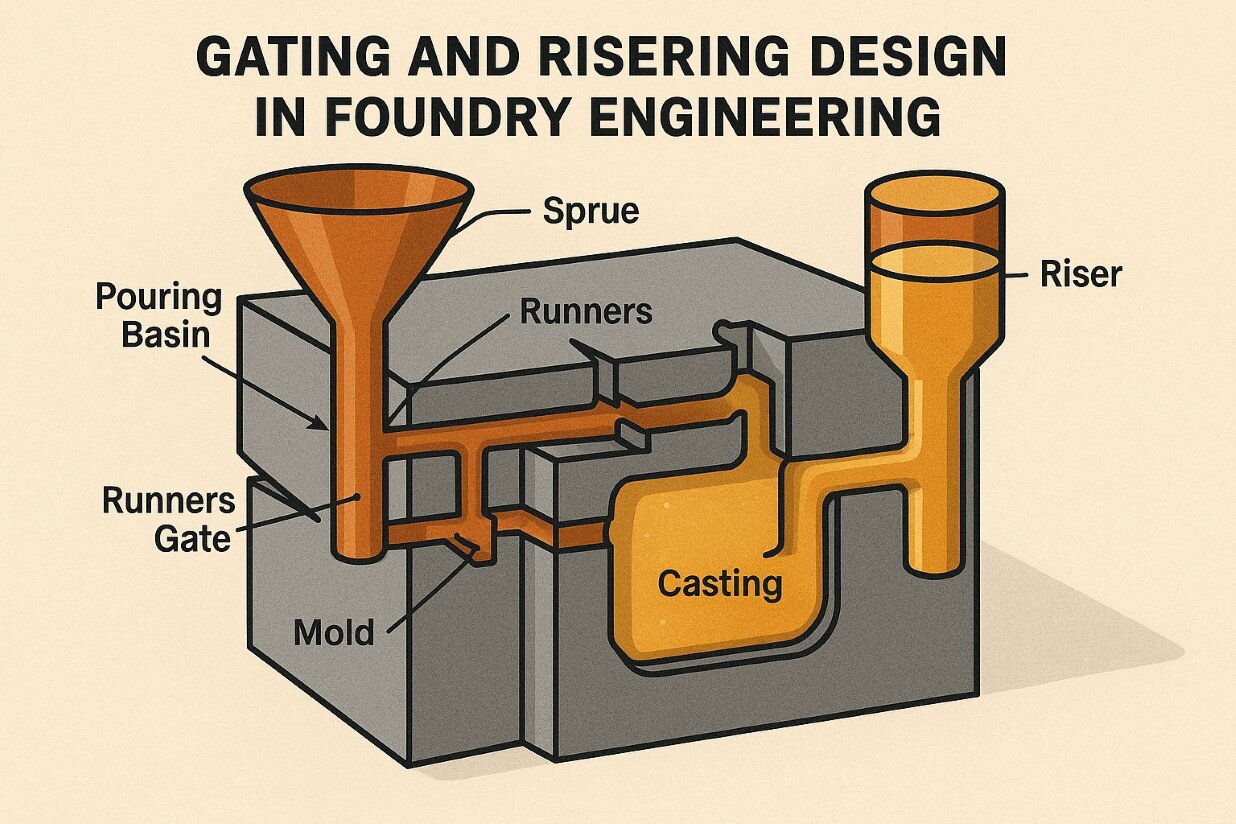
What Are Gating and Risering Systems?
The gating system consists of sprues, runners, gates, and the pouring basin. These channels guide molten metal from the furnace into the mold cavity. A properly designed gating system reduces turbulence, prevents air entrapment, controls metal velocity, and ensures uniform mold filling.
The riser acts as a reservoir for molten metal during solidification. As the casting cools and contracts, the riser supplies additional metal to compensate for shrinkage. This prevents internal cavities or shrinkage-related defects that can weaken the component.
Both systems must work together. If the gating system introduces turbulence, it creates porosity. If a riser freezes too soon, it cannot feed the casting. Proper design requires an understanding of metal flow, heat transfer, and the specific characteristics of each alloy.
Business Impact of Design Accuracy
Gating and risering design directly influence several key production metrics:
• First-pass yield
• Scrap and rework rates
• Machining and finishing time
• Tooling life
• Lead time and delivery performance
• Customer satisfaction and repeat orders
Defects such as cold shuts, misruns, shrinkage, and porosity often result from poor flow paths or inadequate feeding. For OEMs with strict quality standards, these issues can disrupt assembly lines or trigger warranty claims. Foundries that consistently deliver defect-free castings gain a competitive advantage and build stronger long-term partnerships.
Key Principles Used in Gating and Risering Design
High-quality gating and risering systems follow several foundational principles:
• Laminar, controlled metal flow to avoid turbulence
• Directional solidification from thinner sections toward the riser
• Balanced gating ratios to maintain proper metal velocity
• Efficient riser placement and sizing to maintain metallurgical integrity
• Consideration of alloy behavior, fluidity, and pouring temperature
• Accommodation of mold material, core design, and wall thickness
Different materials require specific design approaches. Steel usually requires larger risers due to high solidification shrinkage. Aluminum alloys demand careful control of oxide formation and turbulence. Ductile iron requires attention to nodularity during feeding.
Reusing a gating design from unrelated jobs often leads to poor results because every casting has unique geometry and thermal characteristics.
Role of Simulation Tools in Improving Design Accuracy
Modern simulation tools such as MAGMASOFT, FLOW-3D Cast, and SOLIDCast have improved the precision and predictability of gating and riser design. They allow engineers to visualize flow paths, identify hot spots, and optimize feed paths before tooling is manufactured. However, the effectiveness of these tools still relies heavily on domain expertise. Companies with deep capabilities in foundry engineering can combine simulation data with hands-on process knowledge to design casting solutions that meet specific performance and cost targets.
Experienced foundry engineers combine analytical results with shop-floor realities, adjusting designs to account for factors such as mold handling, pouring speed, and tooling limitations. This hybrid approach reduces development time while ensuring reliability in production.
Why Issues Still Occur in Production
Even with advanced modeling and technical knowledge, defects still arise due to several factors:
• Time pressure during design and quotation
• Copying outdated layouts for new parts
• Lack of communication between design, simulation, and production teams
• Oversimplifying alloy-specific behavior
• Inconsistent pouring practices or mold handling
• High-mix, low-volume production constraints
When gating systems are reused without verification, the result is often increased total cost of quality due to rework, rejections, and delivery delays. A feedback loop between inspection, machining, and design teams helps identify recurring issues and prevent future failures.
Strategic Value of Investing in Gating and Risering Design
Accurate gating and riser design deliver long-term value to foundries and OEMs:
• Higher yield and reduced metal wastage
• Lower cost per casting
• Better casting consistency
• Improved on-time delivery
• Reduced customer complaints
• Enhanced competitiveness
Industries with strict quality requirements—such as defense, heavy equipment, and medical manufacturing-depend on reliable castings. Foundries that invest in planning, simulation, and skilled engineers achieve higher customer retention and better profitability.
Conclusion: Design is a Strategic Process
Gating and risering design is not just a technical formality; it is a strategic foundation of the casting process. It influences quality, cost, productivity, and client confidence. Foundries that prioritize flow optimization, solidification planning, and cross-team collaboration achieve predictable results and avoid recurring defects.
By utilizing modern simulation tools, maintaining engineering expertise, and applying lessons learned from past production runs, companies can consistently deliver sound castings. In competitive B2B manufacturing, strong gating and risering design is a key differentiator that sets one supplier ahead of another.