The internet contains more information today than at any other point in history. Every second, new articles, videos, social media posts, research papers, and business resources are published online. While access to information has never been easier, finding accurate, relevant, and trustworthy answers quickly remains a challenge.
For decades, traditional search engines have been the primary gateway to online information. Users enter keywords, receive a list of links, and manually explore websites to find answers. Although this approach has served billions of people well, the growing complexity of online content has exposed its limitations.
This is where AI search is changing the game.
Powered by advancements in artificial intelligence, natural language processing (NLP), large language models (LLMs), semantic search, and retrieval-augmented generation (RAG), modern AI-powered search engines are transforming how people discover, understand, and interact with information online.
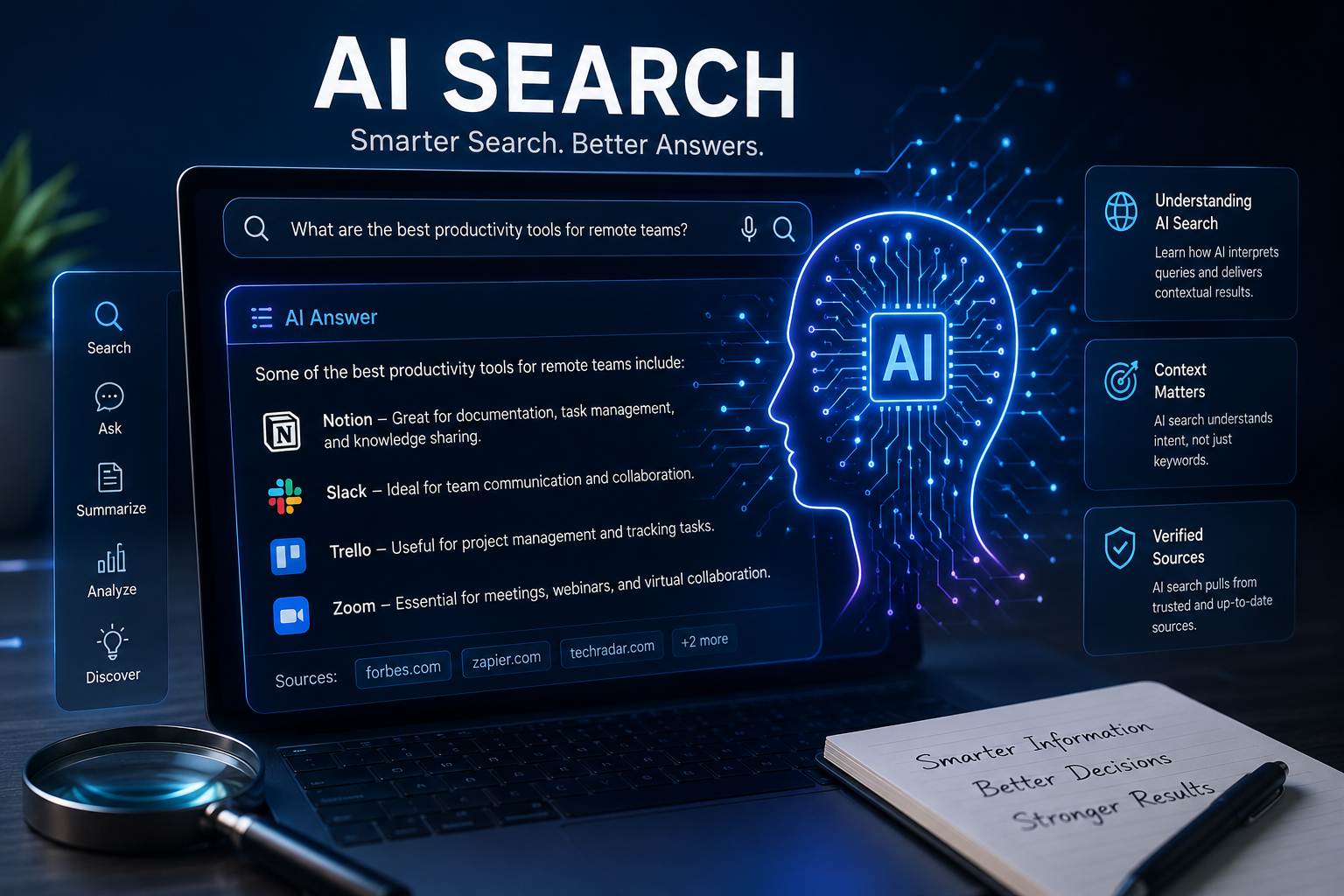
Rather than simply displaying a list of links, AI search tools can understand user intent, summarize information, answer complex questions, and provide conversational experiences that feel more like interacting with a knowledgeable assistant than using a traditional search engine.
In this article, we’ll explore how AI search works, its advantages over traditional search, real-world examples of AI-powered search platforms, and what the future of information discovery may look like.
The Limitations of Traditional Search Engines
Traditional search engines rely heavily on keywords, ranking algorithms, backlinks, and website authority to determine which results users see.
While these systems have become increasingly sophisticated, they still present several challenges:
- Information overload
- Multiple pages of search results
- Conflicting information from different sources
- Time-consuming research processes
- Difficulty evaluating source credibility
- Fragmented answers spread across numerous websites
For example, if a user wants to understand “the impact of AI on healthcare,” they may need to open ten or more websites, compare viewpoints, verify facts, and piece together conclusions manually.
This process consumes valuable time and can create information fatigue.
As the volume of online content continues to grow, users increasingly expect search tools to help them interpret information rather than simply locate it.
What Is AI Search?
AI search refers to search technologies that use artificial intelligence and machine learning to understand user intent and deliver more relevant, contextualized responses.
Unlike traditional search engines that focus primarily on keyword matching, AI-powered search systems analyze:
- Context
- User intent
- Natural language queries
- Semantic meaning
- Relationships between concepts
- Historical interactions
This enables users to ask questions naturally.
Instead of searching for:
"best crm software 2026"
Users can ask:
"What are the best CRM platforms for small businesses that need strong security and automation features?"
The AI system can understand the context and provide a more targeted response.
This shift from keyword-based search to intent-based search is fundamentally changing how information is discovered online.

How AI Search Works
AI-powered search systems combine multiple technologies to deliver intelligent results.
Natural Language Processing (NLP)
Natural Language Processing (NLP) enables computers to understand and interpret human language.
NLP helps AI search engines:
- Understand sentence structure
- Identify user intent
- Recognize entities and concepts
- Interpret conversational language
- Process follow-up questions
For example, when a user asks:
"What are the best AI search tools for researchers?"
NLP helps the system understand that the user is seeking recommendations rather than a definition.
Large Language Models (LLMs)
Large Language Models are advanced AI systems trained on massive amounts of text data.
Examples include:
- ChatGPT
- Gemini
- Claude
- Llama
LLMs enable AI search platforms to:
- Generate human-like responses
- Summarize complex information
- Answer questions conversationally
- Explain technical concepts
- Create contextual responses
Rather than simply retrieving information, LLMs can synthesize information from multiple sources into a coherent answer.
Semantic Search
Semantic search focuses on understanding meaning rather than matching exact keywords.
For example:
"How can I improve team productivity?"
and
"Best ways to make employees work more efficiently"
may use different words but express a similar intent.
Semantic search identifies these relationships and provides relevant results even when exact keywords don’t match.
This dramatically improves search accuracy and user satisfaction.
Retrieval-Augmented Generation (RAG)
One of the most important innovations in AI search is Retrieval-Augmented Generation (RAG).
RAG combines two capabilities:
- Retrieving information from trusted sources
- Generating intelligent responses using AI
Instead of relying solely on what an AI model learned during training, RAG enables systems to access current information and provide more accurate answers.
Benefits of RAG include:
- Improved factual accuracy
- Reduced hallucinations
- Access to up-to-date information
- Better source grounding
- Enhanced enterprise search capabilities
Many modern AI search systems and enterprise knowledge assistants rely heavily on RAG architectures.
Traditional Search vs AI Search
The differences between traditional and AI-powered search are significant.
| Feature | Traditional Search | AI Search |
|---|---|---|
| Query Method | Keywords | Natural Language |
| Results | List of Links | Direct Answers |
| Context Understanding | Limited | Advanced |
| Follow-Up Questions | Difficult | Conversational |
| Information Synthesis | Manual | Automated |
| Personalization | Basic | Context-Aware |
| Research Time | Higher | Lower |
| User Experience | Search-Oriented | Assistant-Oriented |
This evolution represents one of the most significant changes in search technology since the introduction of modern search engines.
Why AI Search is Becoming Popular
Several factors are driving the adoption of AI-powered search platforms.
- Faster Research:
Professionals spend countless hours researching information online.
AI search tools can summarize large amounts of information quickly, reducing research time significantly.
- Better Decision-Making:
By presenting organized insights rather than scattered links, AI systems help users make informed decisions more efficiently.
- Improved Productivity:
Knowledge workers can focus on solving problems instead of searching for information.
- Reduced Information Fatigue:
AI search minimizes the need to navigate dozens of webpages to find answers. This creates a more streamlined user experience.
Real-World Examples of AI Search Platforms
Several AI-powered search tools are already transforming how people find information.
ChatGPT Search
ChatGPT Search combines conversational AI with web search capabilities.
Users can ask questions naturally and receive summarized responses that include relevant sources and context. Read More about ChatGPT for Software Developers
It is particularly useful for:
- Research
- Learning
- Productivity
- Technical explanations
- Content ideation
Perplexity AI
Perplexity AI has emerged as one of the most popular AI search platforms.
Its strengths include:
- Source citations
- Real-time information retrieval
- Research-focused workflows
- Conversational search experiences
Many users prefer it for academic and professional research.
Google AI Search Experience
Google has integrated generative AI features into its search ecosystem.
These AI-generated summaries help users quickly understand complex topics without needing to visit multiple pages immediately.
Google’s approach combines traditional search strengths with AI-powered information synthesis.
Microsoft Copilot
Microsoft Copilot integrates AI-powered search into productivity workflows.
Users can retrieve information, summarize content, and generate insights directly within business applications.
This demonstrates how AI search is becoming embedded in everyday work environments.
There are more platforms, such as https://ai.setapp.com, that support AI-powered information discovery.
AI Search and the Future of Work
Businesses are rapidly adopting AI-powered search technologies to improve efficiency and knowledge management.
Common business applications include:
- Internal knowledge search
- Customer support automation
- Market research
- Competitive analysis
- Document summarization
- Enterprise search systems
Organizations increasingly recognize that employees spend substantial time searching for information.
AI search helps reduce this friction and improve productivity across teams.
As AI capabilities continue to advance, search will become a core component of digital workplace transformation.
Challenges and Considerations
Despite its advantages, AI search is not without limitations.
- Information Accuracy
AI-generated responses can occasionally contain inaccuracies. Users should continue verifying critical information from trusted sources.
- Source Transparency
Not all AI systems clearly indicate where information originates. Transparency is essential for maintaining trust.
- Bias
AI models may reflect biases present in training data. Responsible AI development remains an important priority.
- Privacy Concerns
Organizations must ensure that AI search systems handle sensitive data securely.
- Hallucinations
AI models sometimes generate plausible-sounding but incorrect information. Modern RAG systems help reduce this risk, but it remains a challenge.
The Future of AI Search
The future of search will likely be more conversational, personalized, and intelligent.
Emerging trends include:
- Multimodal search using text, voice, images, and video
- Personalized search experiences
- Real-time knowledge retrieval
- Agent-based AI assistants
- Enterprise AI knowledge platforms
- Hyper-contextual recommendations
Instead of simply finding information, future AI systems will help users understand, evaluate, and act on information more effectively.
Search is evolving from information retrieval to intelligent knowledge assistance.
Conclusion
Artificial intelligence is fundamentally changing the way people discover information online. By leveraging technologies such as natural language processing, large language models, semantic search, and retrieval-augmented generation, AI-powered search engines are delivering faster, more contextual, and more meaningful answers.
As information continues to grow in volume and complexity, traditional search methods alone may no longer be sufficient. AI search platforms are helping bridge the gap by transforming search from a process of finding links into a process of understanding knowledge.
Whether you’re a student, researcher, business professional, or everyday internet user, AI search is reshaping the future of information discovery and creating a smarter, more productive digital experience.
Frequently Asked Questions (FAQ)
What is AI search?
AI search is a search technology that uses artificial intelligence, machine learning, and natural language processing to understand user intent and provide contextual answers instead of simply displaying links.
How is AI search different from traditional search?
Traditional search primarily relies on keyword matching and ranking algorithms, while AI search focuses on understanding intent, context, and semantic meaning to generate more useful responses.
What technologies power AI search?
Key technologies include Natural Language Processing (NLP), Large Language Models (LLMs), Semantic Search, Machine Learning, Vector Databases, and Retrieval-Augmented Generation (RAG).
Is AI search more accurate than traditional search?
AI search can provide faster and more contextual answers, but accuracy depends on the quality of data sources and retrieval mechanisms. Users should verify critical information from trusted sources.
What are the most popular AI search tools?
Popular AI search platforms include ChatGPT Search, Perplexity AI, Google AI Search Experience, Microsoft Copilot, and enterprise AI knowledge assistants.
Will AI search replace traditional search engines?
AI search is likely to complement rather than completely replace traditional search engines. Search providers will continue integrating AI capabilities to improve user experiences.